Contemptuous Meaning: Simple Definition, Examples, Synonyms, and Usage
The contemptuous use is a strong disrespect, scorn or contempt of a person or a thing. When someone is contemptuous, their tone, facial expression or words might convey that they look down on someone else. It is helpful to know the contemptuous meaning as this word is frequently used in books, news reports, in the workplace and in everyday conversation.
Simply, contemptuous means “open disrespect or scorn.” It’s more than just a little bit of disliking. A contemptuous statement is typically a judgmental statement. A look of contempt is a way of showing disrespect without saying anything. With the understanding of a word’s contemptuous meaning, you can begin to identify the emotion it represents.
What Is the Contemptuous Meaning?
Contemptuous meaning is an attitude of disrespect for a person, idea, action or situation. When they respect someone, they feel it is worthy of their attention.
If you need to know the meaning of contemptuous, it’s defined as: showing disrespect, scorn, or contempt.
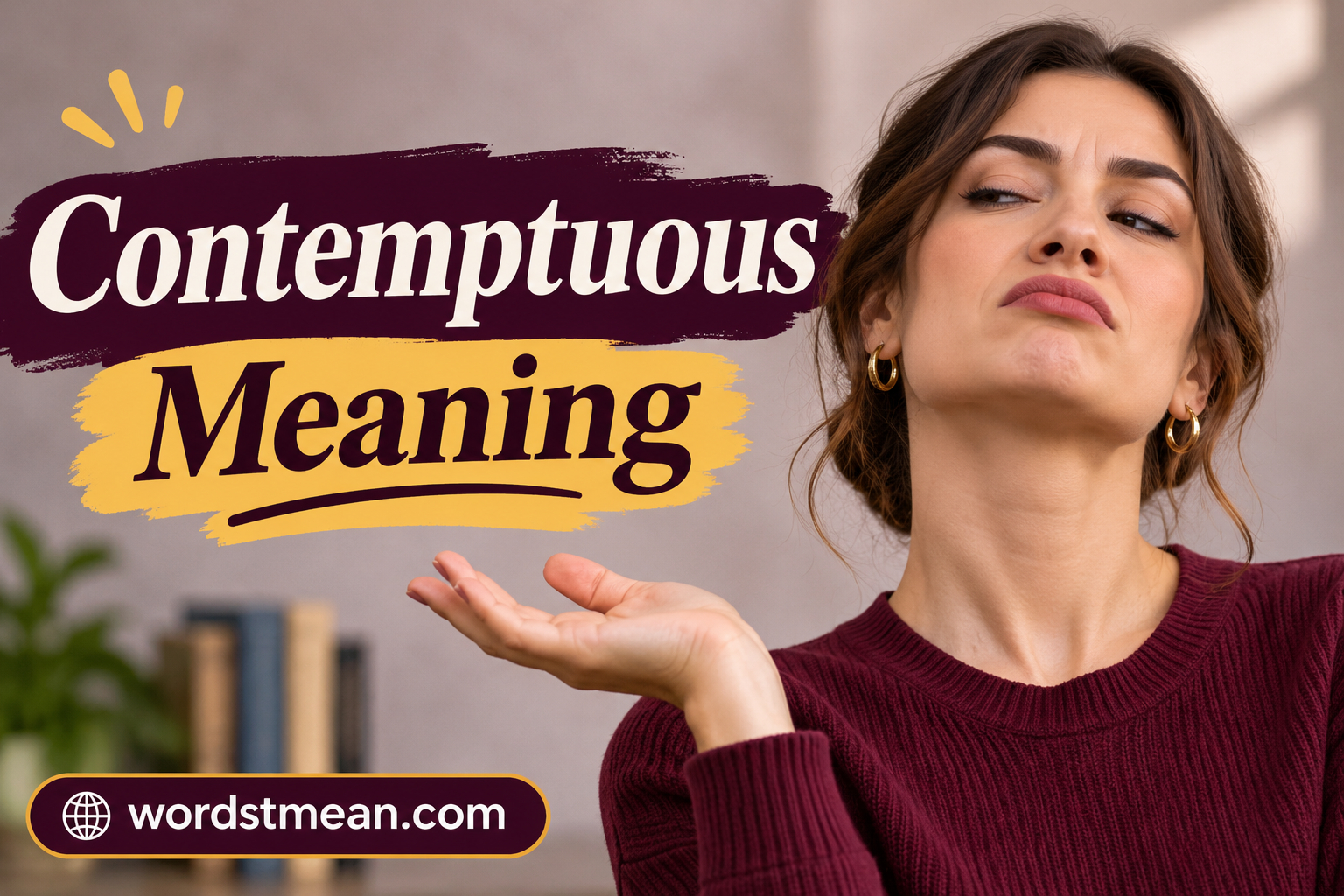
For instance, when a person who wants to express a negative view smirks when hearing another person’s view, a contemptuous smile may be an indication that the person thinks the other person’s opinion is silly or not worth their while. That is why, when the meaning is contempt, it’s frequently more about the body language than the words.
Contemptuous helps you get a clear understanding of a word’s meaning in a non-technical way.
The contemptuous meaning in simple words is “showing that you have little or no respect for someone or something.” It can refer to a tone of voice, expression, smile, comment, gesture or mannerism.
Consider the expression of a person with their eyes rolling and talking condescendingly. This action can be disrespectful. The contemptuous definition is more clear when paired with visible elements of scorn, disrespect or superiority.
Contemptuous Meaning Fact Table
| Item | Explanation |
| Word | Contemptuous |
| Part of speech | Adjective |
| Contemptuous meaning | Showing strong disrespect, scorn, or contempt |
| Simple meaning | Looking down on someone or something |
| Tone | Negative |
| Common use | Speech, facial expressions, attitudes, reactions |
| Related noun | Contempt |
| Related adverb | Contemptuously |
| Opposite ideas | Respectful, admiring, considerate |
| Example | She gave a contemptuous laugh when the idea was mentioned. |
The contemptuous meaning is closely tied to the noun “contempt.” Contempt is the feeling that someone or something deserves little respect. The adjective “contemptuous” describes behavior that shows that feeling.
Read Also: Wild Abandon Meaning: Definition, Examples, Usage, and Similar Terms
How the Contemptuous Meaning Works in a Sentence
It is easier to remember the contemptuous meaning if you see it in context. It can refer to how someone speaks, behaves, looks, and/or responds.
Here are some examples of the factors to consider:
- The tone with which he spoke was disrespectful to the topic under discussion.
- She looked disdainful at him and went away.
- The manager scoffled disapprovingly.
- His scoffing comments angered the others.
- The article was derisive of the proposal.
Each sentence uses the contemptuous sense, which is a sense of disrespect. The person is NOT just disagreeing. They act as if they think that someone or something is less than, silly, or unworthy.
Contemptuous Meaning With Real-Life Examples
You may hear the word in many settings. Understanding the contemptuous meaning helps you read the emotional tone more accurately.
At Work
Imagine an employee sharing an idea during a meeting. Another employee smirks and says, “That is the worst plan I have heard all year.” The contemptuous meaning fits because the response does more than criticize the idea. It shows scorn.
In a Relationship
One partner may answer another with mocking laughter or repeated eye-rolling. In this setting, the contemptuous meaning can describe behavior that communicates disrespect and superiority.
In School
A student may give a contemptuous response to a classmate who answers a question incorrectly. The contemptuous meaning here points to the student’s insulting or dismissive attitude.
In Public Debate
A speaker may use a contemptuous tone when referring to an opponent. The contemptuous meaning suggests that the speaker is not just challenging the argument but showing disdain toward the person or position.
Similar Words and Alternatives to Contemptuous Meaning
Several words are close to the contemptuous meaning, but they are not always identical.
| Similar Word | Basic Sense | Example |
| Scornful | Showing strong disrespect | He gave a scornful reply. |
| Disdainful | Showing that something is beneath your respect | She looked disdainful during the discussion. |
| Disrespectful | Lacking respect | His comment was disrespectful. |
| Mocking | Making fun of someone | They used a mocking tone. |
| Sneering | Showing contempt through words or expression | He gave a sneering smile. |
| Dismissive | Treating something as unimportant | Her answer sounded dismissive. |
| Derisive | Expressing ridicule | The crowd gave a derisive laugh. |
| Condescending | Talking down to someone | His condescending reply annoyed the team. |
The closest alternatives to the contemptuous meaning are often “scornful,” “disdainful,” and “sneering.” Still, each word has a slightly different shade of meaning. “Dismissive” may be less intense. “Mocking” focuses more on ridicule. The contemptuous meaning usually combines disrespect with a sense of superiority.
Contemptuous Meaning vs Disrespectful
The contemptuous meaning conveys a deeper meaning than merely disrespect. A disrespectful person may not obey rules or use rude words. A contemptuous person tends to convey that another person or idea is unworthy of respect.
For instance, if you interrupt another person, it may be a sign of not respecting them. To sneer at their opinion and to dub it pathetic is contemptuous. There is an added layer of scorn to the contemptuous meaning.
Contemptuous Meaning vs Condescending
The words contemptuous, with the implication of “condescending,” are not synonymous, but they can share a similar significance. Someone who speaks or acts in a superior manner. A contemptuous person is someone who is more disrespectful or disgusted towards a person.
If a teacher explains to his/her students something in a patronizing and simple manner, the teacher may sound condescending. If someone laughs at a beginner and says that he or she is useless, it will sound contemptuous. The contemptuous definition is typically more severe.
Contemptuous Meaning vs Scornful
One of the most similar synonyms is scornful. Both words mean a high degree of disrespect. The contemptuous meaning often carries a connotation of viewing with contempt. The word scornful can mean open scorn, or rejection.
Either word can be used in many sentences. However, the derogatory sense might relate to a general tone of voice, and “scornful” may refer to an outward expression of scorn.
Signs of a Contemptuous Attitude
Once you know the contemptuous meaning, you can spot it through common signs. These signs may include:
- Eye-rolling
- Sneering
- Mocking laughter
- Sarcastic remarks
- Insulting comparisons
- Dismissive gestures
- A superior tone
- Open ridicule
Not every sarcastic comment is contemptuous. Context matters. The contemptuous meaning applies when the behavior shows clear scorn or a lack of respect.
How to Pronounce Contemptuous
“Contemptuous” is commonly pronounced as kuhn-TEMP-choo-us.
Breaking the word into parts can help:
con-TEMP-tu-ous
Learning the pronunciation can make the contemptuous meaning easier to use in spoken English. The main stress usually falls around “temp.”
Word Forms Related to Contemptuous Meaning
The contemptuous meaning connects to a small family of useful words.
| Word | Part of Speech | Meaning | Example |
| Contempt | Noun | A feeling of strong disrespect | He spoke with contempt. |
| Contemptuous | Adjective | Showing contempt | She gave a contemptuous reply. |
| Contemptuously | Adverb | In a contemptuous manner | He laughed contemptuously. |
Knowing these forms helps you understand the term in different sentence patterns.
Examples of Contemptuous Meaning in Different Tones
The term can appear in formal writing, casual speech, fiction, journalism, and commentary.
Formal Example
“The witness responded in a contemptuous manner toward the opposing counsel.”
Here, the wording suggests visible disrespect in a formal setting.
Casual Example
“He gave me a contemptuous look when I asked the question.”
In casual speech, the term often describes a facial expression or tone.
Fiction Example
“She turned away with a contemptuous smile.”
Writers use this word to show emotion quickly without explaining every thought a character has.
News or Commentary Example
“The official made a contemptuous remark about the criticism.”
In reporting, the term may help describe the emotional character of a statement.
Why Understanding Contemptuous Meaning Matters
Knowing this definition improves reading comprehension and helps you understand tone. It is especially useful in literature, opinion writing, workplace communication, and social situations.
The word signals more than disagreement. It tells you that disrespect is present. If a writer describes a character as contemptuous, you can infer that the character feels scorn or superiority. That emotional detail is central to the term.
It also helps with writing. Instead of saying someone was “very rude,” you can use “contemptuous” when the situation involves open scorn. Using the word correctly makes the sentence more precise.
When Should You Use the Word Contemptuous?
Use “contemptuous” when someone shows strong disrespect, scorn, or disdain. The word works best when the person’s attitude is stronger than simple annoyance.
You might use it for:
- A contemptuous expression
- A contemptuous laugh
- A contemptuous remark
- A contemptuous tone
- A contemptuous attitude
- A contemptuous response
The term is less suitable when the person is only frustrated, upset, or disagreeing politely.
Read Also: Dover Meaning: Origin, Name History, Symbolism, and Common Uses
Common Mistakes With Contemptuous Meaning
A frequent error is using the word in place of the word “angry.” It is possible to be contemptuous without being outwardly angry. They can remain quiet and talk condescendingly or condescendingly to them.
Another error is to use “contemptuous” instead of “contemptible.” These words have a common meaning but are not synonymous. Contemptuous – exhibiting contempt. Contemptible = worthy of contempt.
For example:
- Scornful words demonstrate disrespect.
- The dishonorable act can warrant scorn.
This difference can be easily remembered, and the word will be used correctly
Quick Summary of Contemptuous Meaning
It is used to mean “to disrespect, to scorn, to disdain”. It is usually expressed in tone, facial expression, gestures, or by insulting language. Synonyms are scornful, disdainful, mocking, sneering and derisive. The word is firmer than disrespect as it occasionally implies that the speaker feels a person or idea is not deserving of respect.
Remember one thing, remember this: It’s not just dislike. It’s a mixture of dislike and superiority.
Final Thought
Understanding the contemptuous meaning makes it easier to recognize strong disrespect in speech, writing, facial expressions, and everyday behavior. A contemptuous person does more than disagree. They show scorn and often act as if another person or idea is beneath their respect. Words such as scornful, disdainful, and mocking can have similar meanings, but context matters. Once you understand the contemptuous meaning, you can use the word more accurately and identify its tone with confidence.
FAQs About Contemptuous Meaning
What is the contemptuous meaning in simple English?
It means showing strong disrespect or acting as if someone or something is beneath your respect.
What is a synonym for contemptuous?
A close synonym is scornful. Other options include disdainful, sneering, derisive, mocking, and disrespectful.
What is an example of contemptuous?
“She gave a contemptuous laugh at his suggestion” is a clear example because the laugh shows scorn.
Is contemptuous a negative word?
Yes. It is negative because it describes scorn, disrespect, or disdain.
What is the difference between contemptuous and contemptible?
Contemptuous means showing contempt. Contemptible means deserving contempt.
Can a look be contemptuous?
Yes. A contemptuous look may include a sneer, eye-roll, or expression that communicates strong disrespect.
What does contemptuously mean?
“Contemptuously” means doing something in a way that shows contempt, scorn, or strong disrespect.
Is contemptuous the same as rude?
Not exactly. Rude means impolite. Contemptuous is stronger and often shows scorn or a sense of superiority.