
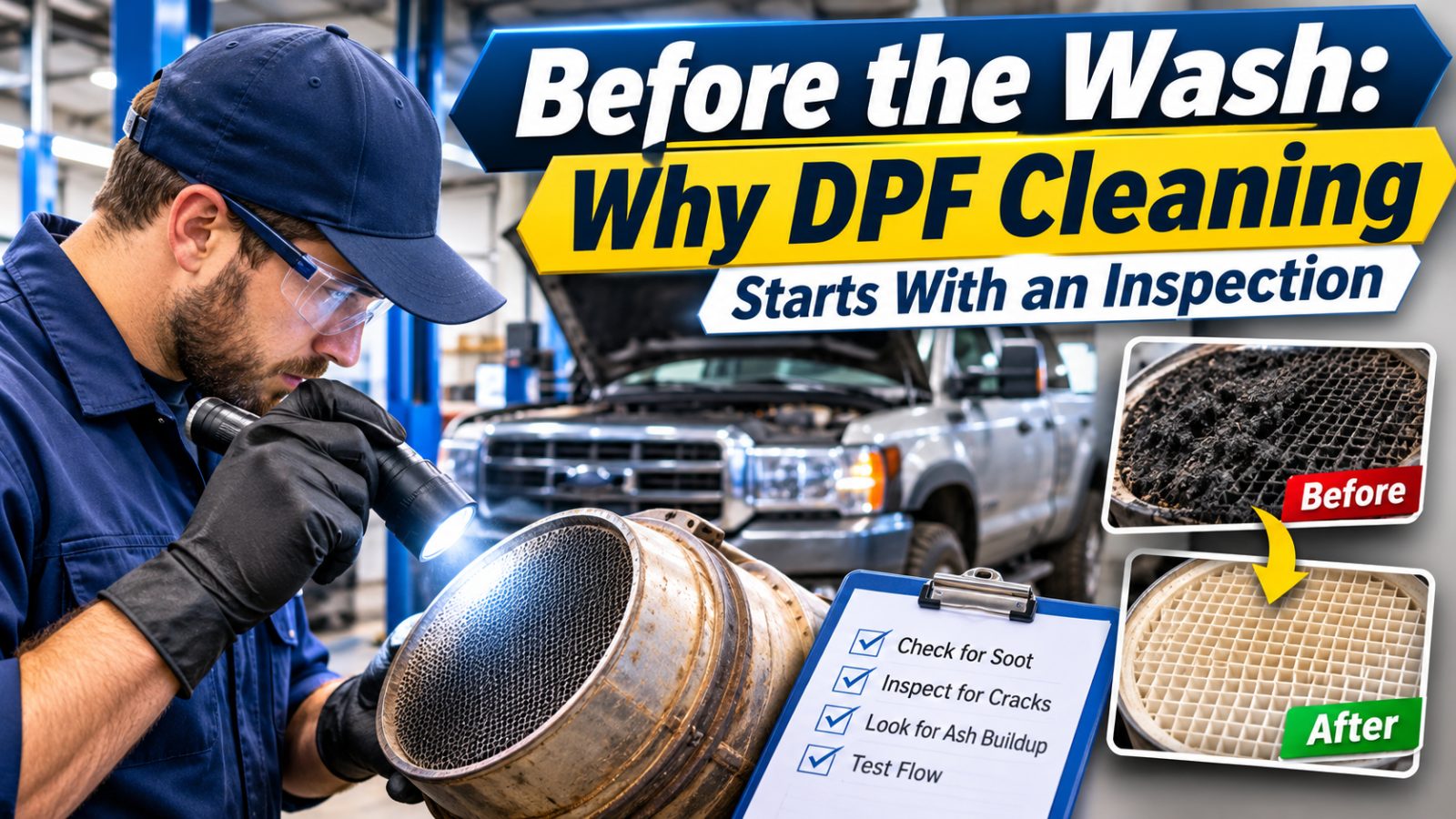
Before the Wash: Why DPF Cleaning Starts With an Inspection
When a diesel truck keeps throwing a particulate filter warning, the instinct is to treat the filter as a dirty part and send it out for cleaning. Sometimes that’s right. Just as often, a full filter is a symptom of something else, or the filter is no longer fit to go back on the vehicle. A professional DPF filter cleaning service in Connecticut earns its value in the assessment around the wash, not only in the wash itself. Here is what that process generally involves and why the inspection matters as much as the cleaning.
Two Kinds of Buildup, Two Different Fixes
A diesel particulate filter is a ceramic honeycomb that traps exhaust particulates. What it collects falls into two categories, and only one can be handled on the vehicle.
Soot is carbon from incomplete combustion. The engine’s regeneration strategy, whether passive, active, or a forced regen run with a scan tool, uses heat to oxidize soot so it leaves as gas. When a truck’s duty cycle rarely lets the exhaust get hot enough, soot piles up faster than it burns off. A successful regeneration can often clear it.
Ash is a different matter. It is the incombustible residue left by metallic additives in engine oil, and to a lesser extent fuel. Regeneration does not remove it. Ash stays in the channels, taking up filter volume, raising baseline backpressure, and shortening the miles between regens. According to Fleet Maintenance, engine manufacturers use control-module strategies to estimate ash percentage and to recommend when a filter should come off for cleaning.
This explains a common frustration: a filter that regenerates successfully but reads “full” again soon afterward. If ash is the problem, another forced regen won’t help. Off-vehicle service enters the picture at that point.
Stage One: Assessment Before Anything Is Cleaned
A sound service starts with information. The shop will typically ask about fault codes, regen history, mileage, and recent engine work, and may scan for codes and check pressure readings. Once the filter is off the vehicle, a technician inspects it.
Fleet Maintenance’s reporting on dealer inspection criteria describes a largely visual process: examining the inlet and outlet faces of the substrate, the can, and the flanges under good light. The outlet side is especially revealing. A filter should show no soot on its clean side, and soot there is a telltale sign of an internal crack or breakdown. Inspectors also look for:
- Cracks in the ceramic, including internal cracks that never reach the surface
- Melted or fused substrate, which points to an extreme heat event
- Gouges or missing plugs beyond a manufacturer’s tolerances
- Foreign material or contamination on the filter face
- Dented or distorted cans and flanges, or a shifted brick
This comes first because cleaning a cracked filter wastes money. Noregon’s Lee Lackey told Fleet Maintenance that trying to stretch the life of a cracked DPF puts both the truck and the environment at risk.
The Filter Is Often the Casualty, Not the Cause
Technicians repeat one observation: most DPF replacements trace back to something upstream. Dustin Carnes of Diesel Laptops told Fleet Maintenance that oil, fuel, or coolant contamination and uncorrected engine problems can severely damage a filter that was only doing its job. A turbo seal leak, an over-fueling condition, or an EGR fault can saturate the filter with oil or excess soot, or set up an uncontrolled burn. Clean the filter without finding the cause, and the same problem comes back early. Faulty sensor readings and exhaust leaks can also make a healthy filter look restricted, which is one more reason diagnosis belongs ahead of cleaning.
The same logic applies to neighboring components. A tired diesel oxidation catalyst supplies much of the heat that regeneration depends on, so a worn one can keep regens from completing even after a flawless filter cleaning. An explainer on diesel oxidation catalyst walks through that relationship in more detail.
Stage Two: Cleaning, and Why No Single Method Fits Every Filter
Industry sources describe several approaches: thermal “bake and blow” processes, pneumatic or air-pulse cleaning, and aqueous washing, sometimes combined. Manufacturers hold their own positions. Detroit has promoted a proprietary liquid wash followed by thermal cleaning. Cummins’ guidance, as reported by Fleet Maintenance, treats field cleaning as a cost-effective option at a filter’s first recommended service and favors an OE replacement after that. Lackey’s advice was simply that each OE has different recommendations and owners should follow them.
For an owner, the takeaway is that the right method depends on the filter’s design, its condition, and what loaded it. Light soot, heavy ash, and oil saturation are different jobs. A provider should be able to explain why a particular approach suits your filter rather than presenting one process as the answer to everything.
Results vary for the same reason. A lightly loaded, intact filter and one that has been through several cleanings or been soaked with oil won’t respond the same way, and a responsible shop won’t promise otherwise.
Stage Three: Checking the Result
A filter isn’t finished when it looks clean. Post-cleaning evaluation commonly includes flow or restriction testing compared against pre-cleaning measurements, plus a second visual check. Lackey recommends a flashlight test after cleaning to confirm success or decide that replacement is the better course.
Some providers build the process around these bookends. 30 Minute DPF Clean, for example, describes scanning fault codes and checking soot and ash levels before touching the filter, then running an air flush and flow test afterward.
Reinstallation matters too. After a clean or replacement, the control module’s soot and ash values generally need to be reset or updated according to the manufacturer’s procedure. Carnes cautioned that unnecessary resets can throw off the module’s calculations, leaving ash accumulation unaccounted for.
When Cleaning Isn’t the Right Call
Cleaning makes sense when the substrate is intact and the restriction comes from soot and ash. It is usually the wrong call when:
- The ceramic is cracked, melted, or fused
- The filter fails a flow test after a proper cleaning, or repeated cleanings no longer hold
- Oil or coolant contamination is present and its source hasn’t been fixed
- Can or flange damage compromises the seal or the mounting
In those cases the next step is repair of the root cause, such as the turbo, injector, EGR, or sensor, followed by a remanufactured or new filter, depending on the damage and the manufacturer’s guidance. The cleaning bill matters less than whether the filter is worth reinstalling.