
Cancelation or Cancellation – What’s the Difference?
Cancellation or cancelation refers to the act of stopping or calling off something, such as an event or an appointment. Both words have similar meanings but are spelled differently. The key difference lies in the use of one L or two L’s, which causes confusion for many people.
Have you ever wondered which spelling is correct? Knowing the difference between cancellation and cancelation can improve your writing and help you avoid simple mistakes. This small detail can make your writing look more professional and clear.
The correct spelling is cancellation with two L’s. It is widely accepted in both formal and informal writing. Though some people use cancelation, especially in American English, it is less common and not preferred in most professional settings.
Common Mistakes When Using “Cancellation” and How to Avoid Them
One of the most common English grammar mistakes is confusing the spelling of “cancelation” and “cancellation.” The reason this happens is that both words are closely related, and their meaning is very similar. However, one of them is the correct spelling while the other is a rarely used variation.
The correct form is cancellation with a double L. It’s the accepted and standard form in most cases. On the other hand, cancelation is a less common and nonstandard variant that is occasionally seen, particularly in American English. If you’re writing formally or professionally, it’s always best to stick with cancellation.
To avoid this common mistake, remember that when cancel is used as a verb, it typically follows the English spelling rules that involve doubling the consonant when adding a suffix like -ation. So, “cancel” becomes “cancelling” in British English, and when you add -ation, it forms “cancellation” with a double L. This pattern follows basic spelling conventions in English.
How to Spell Related Words: Cancel, Canceling, Cancellation Explained
Now, let’s take a closer look at how canceling, cancelling, and cancellation fit into the overall puzzle of English spelling.
Cancel vs Cancellation
The word cancel is the verb form of the word, meaning to stop or call off something. When you change this verb to a noun to describe the act of stopping something, you add the suffix -ation to form cancellation. In American English, “canceling” has just one L, while in British English, it’s spelled cancelling with two L’s. But no matter where you are in the world, the noun form, “cancellation,” always uses two L’s.
Here’s a quick look at the common verb and noun forms:
| Form | American English | British English | Spelling Rule |
| Cancel (verb) | Cancel | Cancel | No change |
| Canceling (verb) | Canceling | Cancelling | One L (US), two L’s (UK) |
| Cancellation (noun) | Cancellation | Cancellation | Always two L’s |
Which Countries Prefer “Cancellation” Over “Cancelation”?
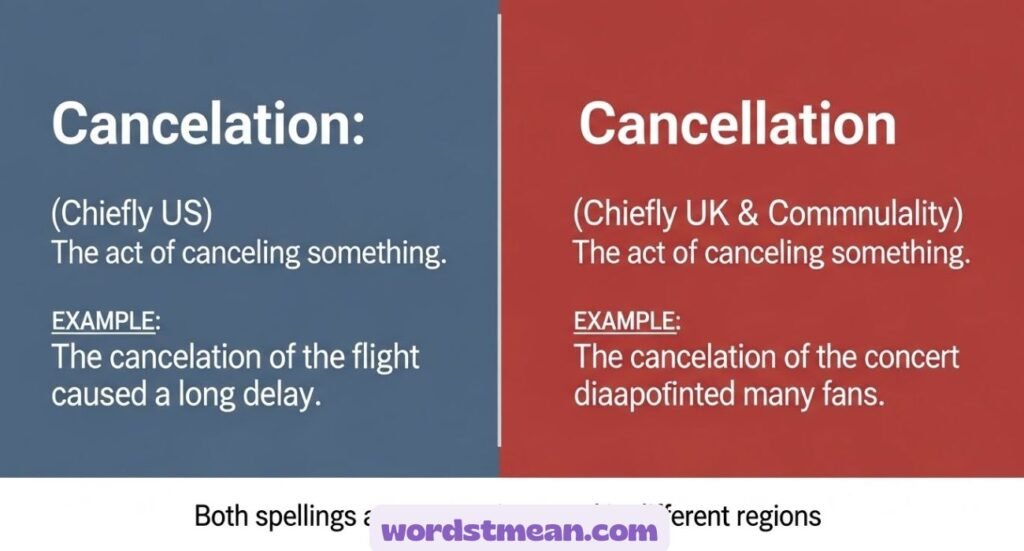
The spelling cancellation is preferred almost everywhere around the world, especially in British English. Countries like the UK, Canada, Australia, and New Zealand follow the British spelling conventions, where the double L in cancellation is the norm.
In contrast, cancelation with one L is much less common and primarily used in American English. Even there, cancelation is rarely used in formal writing. In fact, style guides like Merriam-Webster and the Oxford English Dictionary both list cancellation as the correct form, recommending its use over the cancelation spelling.
So, if you’re aiming to communicate clearly and professionally with an international audience, it’s always safest to stick to the standard English spelling of cancellation.
The Impact of Spelling Differences on Professional Writing
In professional writing, getting the correct spelling in business and formal documents is critical. Using the wrong form—like cancelation—can make you seem careless or unprofessional. Imagine sending an email or a formal letter with an obvious spelling mistake. It might cause your reader to question your attention to detail, which can impact your credibility and your message’s effectiveness.
Whether you’re drafting a business proposal, writing a report, or composing a legal document, you must adhere to spelling rules in English. The correct spelling of cancellation will reflect professionalism, respect for language standards, and an understanding of spelling conventions.
Quick Tips to Remember the Correct Spelling Every Time
One way to make sure you always get the spelling right is to break down the word. Think of it like this: the verb cancel becomes cancelling when you add the “-ing” suffix in British English. Then, when you add -ation, the word becomes cancellation with two L’s. A simple mnemonic to remember is: “Can-cell-ation”.
Another way to check is to use trusted spelling guides such as Merriam-Webster or Oxford English Dictionary, which always list cancellation as the correct form.
How Spell Checkers Handle “Cancellation” vs “Cancelation”
Many people rely on spell checkers to catch spelling mistakes, but these tools are not foolproof. Depending on your device settings and the language selected, spell checkers may allow cancelation to pass without flagging it as an error, even though it’s technically incorrect.
If you’re using a spell checker and it doesn’t catch cancelation spelling errors, don’t assume the word is correct. Always double-check against a trusted dictionary to avoid spell check errors. In business communication spelling, precision is key, and relying solely on spell check may lead to embarrassing mistakes.
Pronunciation Guide: Does Spelling Affect How You Say It?
Good news: the pronunciation of cancellation and cancelation is the same! Whether you use cancellation spelling or cancelation spelling, the pronunciation doesn’t change. Both words are spoken as /ˌkæn.səˈleɪ.ʃən/ and sound like “can-suh-LAY-shun.”
The double L in English does not affect the spoken version of the word, so don’t worry about altering how you say it based on the spelling you choose. This makes it easier to focus on the correct spelling in writing while maintaining confidence in your spoken English.
Is “Cancelation” Ever Considered Correct? Grammar Experts Weigh In
Though cancelation is technically not wrong, it is rarely used in formal writing, and many grammar experts agree that it should be avoided in favor of cancellation. Some historical texts from earlier English periods may use cancelation, but over time, cancellation became the standard spelling.
For professional or formal business language, it’s best to follow the standard English spelling of cancellation. Using this form will prevent any confusion or potential mistakes in documents, emails, or other professional communication.
How to Use “Cancellation” and “Cancelation” in Business Communication
When communicating in a business setting, correct spelling in business materials is crucial. For instance, consider a situation where you’re writing an email to a client to inform them that a meeting has been called off. Using the correct cancellation noun will ensure your message is professional and clear.
Imagine the confusion if you wrote: “Due to the cancelation of the meeting…” Instead, “Due to the cancellation of the meeting…” is the correct choice. Using cancellation spelling avoids making spelling mistakes that could harm your professional image.
The Evolution of the Word: From Latin Roots to Modern Usage
The word cancelation (or cancellation) comes from the Latin word “cancellare,” meaning “to cross out” or “make void.” Over time, this root word evolved into the English verb “cancel” and eventually became a noun in the form of “cancellation.”
The addition of -ation transformed the verb into a noun, which describes the action or result of canceling something. The double L in English naturally formed as part of this transition, following English spelling rules for words that end with a short vowel.
How Media Style Guides Treat “Cancellation” vs “Cancelation”
Media outlets like BBC, CNN, and The New York Times follow strict spelling rules in media, which always favor cancellation with two L’s. For consistency and clarity, journalists and editors around the world use cancellation when referring to the act of stopping something.
Following these style guides ensures that your writing aligns with international English standards, helping you produce content that is professional and trusted by readers.
“Cancel Culture” vs “Cancellation”: Are They Related?
Despite sharing a similar root word, cancel culture and cancellation have very different meanings. Cancel culture refers to a social movement where individuals or groups withdraw support from public figures or organizations due to controversial actions or statements. On the other hand, cancellation is simply the act of stopping or calling something off, like a meeting or event.
So while both terms share the idea of “stopping” something, they are used in very different contexts.
What Do News Outlets and Publishers Prefer? A Closer Look
Leading publishers and news outlets like Reuters and The Associated Press follow editorial standards that prioritize cancellation as the correct form. These standards are used to maintain clarity, professionalism, and consistency in published content.
Cultural Preferences: How Spelling Reflects Regional Identity
Finally, spelling variations like cancelation vs cancellation often reflect the regional identity of different English-speaking countries. While cancelation may occasionally appear in casual American spelling, cancellation is the preferred form for formal and professional writing. This shows how language and regional identity play a role in the way we communicate.
Editorial Standards: Which Spelling Do Major Brands Use?
Major brands like Amazon, Google, and Apple are highly consistent in their communication. In all their official documents and customer communications, they use cancellation with two L’s. By following standard English spelling, these brands maintain professionalism and clarity in their content.
Read Also : Requester vs Requestor: Spelling, Use & Examples (2026)
The Importance of Correct Spelling in Professional Writing
Spelling mistakes in professional writing can easily undermine your credibility, especially when it comes to formal documents. The word “cancellation,” when spelled correctly, demonstrates attention to detail. A small error like using “cancelation” can make your message appear careless, even if the rest of the content is clear and well-written.
Whether you’re crafting a business proposal, an email, or a formal letter, correct spelling is crucial. It shows you respect language conventions and care about delivering a polished message. Even if the error is subtle, it can affect how your work is perceived by others in the professional world, especially in international communication.
Understanding the Verb and Noun Forms of Cancel
The confusion between cancelation and cancellation often stems from the verb form cancel and how it evolves into a noun. In English, when adding suffixes like -ation, the double L in cancellation forms naturally from the verb, especially in British English. It’s part of standard English language rules that double consonants are added in many cases.
In American English, the spelling of verbs can often differ in forms like canceling vs. cancelling, but the noun form cancellation should still be consistent with two L’s. Understanding these rules will help you write confidently and without error, especially when you’re referring to an action or event that has been called off.
How Regional Differences Affect English Spelling
English spelling varies not just across countries, but even within different contexts. For instance, cancelation is more likely to appear in American English, while the cancellation form dominates in British English, Canada, and Australia. These regional spelling differences often reflect the broader language evolution and historical influences on the language.
Understanding these distinctions is crucial, especially if you’re writing for a global audience. Using the correct form that aligns with the regional identity of your readers or audience will help prevent confusion and ensure your message is well-received. Recognizing these variations enhances the clarity of your writing across international contexts.
Why “Cancelation” Is Rarely Used in Business Writing
In business communication, consistency is key. The term cancelation, although grammatically valid, is much less preferred in formal settings. Cancellations are frequently encountered in emails, contracts, and official notifications, so adhering to the correct spelling of cancellation ensures professionalism. Using the right form keeps your communication error-free and consistent.
In any industry, small details like correct spelling make a huge difference. A misspelled word like cancelation can detract from the clarity of your message, especially when it’s presented in formal business correspondence. Always double-check for accuracy in spelling to maintain a polished and professional tone in all your written work.
The Role of Spell Checkers in Correct Spelling
While spell checkers are useful tools, they are not foolproof. Many spell-checking programs do not flag the word cancelation as incorrect, even though it’s a nonstandard spelling. Spell check errors can slip through, particularly if the tool is set to American English, where cancelation sometimes appears.
Relying solely on spell checkers for grammar and spelling accuracy is risky. It’s always a good practice to manually verify terms like cancellation vs cancelation in trusted dictionaries or style guides, especially when preparing professional materials where precision matters.
Language Evolution and Spelling Conventions
The evolution of cancellation can be traced back to the Latin root word cancellare, meaning to “cross out” or “make void.” Over time, English spelling rules have shaped how we use the word today. The double L form in cancellation is part of these evolving language conventions, which continue to follow phonetic and grammatical patterns from earlier times.
The development of English as a global language has led to various spelling conventions across countries. Some words have evolved differently in the American vs British English spelling systems. Understanding this history of word development helps you choose the correct form and navigate between regional spelling preferences.
How Spelling Affects Your Writing Confidence
The way we spell words directly impacts how we approach writing. Incorrect spelling can cause self-doubt, even if the rest of your writing is flawless. Using the correct spelling variation, such as cancellation, ensures that your writing is clear, professional, and free from avoidable mistakes. This confidence helps maintain focus on your content.
When you understand the proper usage of terms like cancelation and cancellation, you gain confidence in your writing. You no longer second-guess your choices and can focus on delivering a well-crafted message. This confidence is key to becoming a better writer in any professional or academic setting.
The Difference Between Cancel Culture and Cancellation
While cancel culture and cancellation share a common root in the word cancel, they refer to very different concepts. Cancellation typically refers to an event or appointment being called off, while cancel culture refers to a social phenomenon where individuals or entities are publicly condemned for controversial behavior.
The two terms are not interchangeable, and it’s important to use them in their correct contexts. Understanding the language evolution of these terms helps to clarify their distinct meanings and avoid confusion in writing and speech.
FAQs
Which is correct, cancelation or cancellation?
Cancellation with two L’s is the correct and standard spelling.
Is it cancellation or cancelation in the US?
In the US, both cancelation and cancellation can be used, but cancellation with two L’s is preferred in formal writing.
What does cancellation mean?
Cancellation refers to the act of calling off or nullifying something, such as an event, service, or agreement.
Does cancellation have one or two L?
Cancellation has two L’s in both American and British English, though cancelation with one L is sometimes used in informal American English.
Conclusion
It is important to know the correct spelling of words like cancellation and cancelation. The correct form is cancellation with two L’s, and this is the preferred spelling in both formal writing and official documents. While cancelation with one L is sometimes seen in American English, it is not widely used and is considered less standard.
Using the right spelling helps you look more professional and shows attention to detail in your writing. Whether you are writing a school report, an email, or a business letter, always choose cancellation over cancelation. By doing this, you will avoid mistakes and communicate clearly with confidence. Following this simple rule will improve the quality of your writing and ensure that others take you seriously.